
War Memorial
The Eccleshall Great War Project
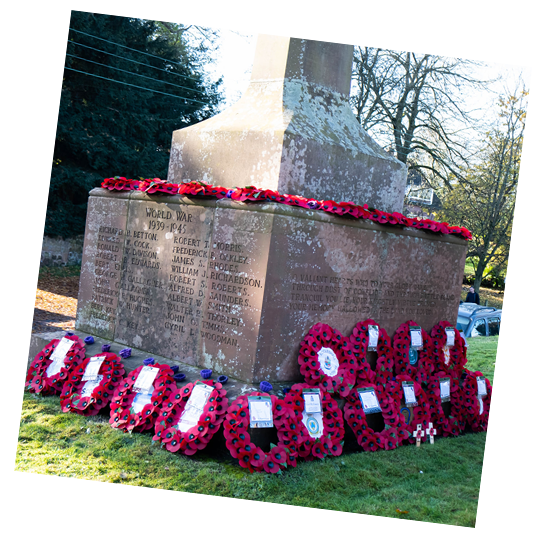
In 2013, the Eccleshall Historical Society instigated a project to research the 46 names on the War Memorial in Holy Trinity Churchyard to commemorate the anniversary of the Great War. Who were the 46 men and women who gave their lives and had direct links to Eccleshall? Within nine months, the research was complete, a great success and a limited edition of a book documenting that research was produced in time for the Eccleshall Festival week of 2014. The project was led with enthusiasm and precision by Eccleshall resident Mr Dennis Joyner who died in 2025. The project, and all that resulted from it, serves as a fitting memorial to Dennis.
During the research, it became clear that there may well have been other names that could be regarded as missing!
A second phase of the project was started to research all possible names that could be considered for recognition. The criteria were as follows:
- A strong connection with Eccleshall Parish.
- Recognised by the C.W.G.C. as casualties.
- Not remembered on any local war memorial.
By late 2015, a list of 17 names was officially recognised as eligible to be put forward to be added to the memorial. Funding was raised, and the necessary permissions and protocols were secured for the names of 17 Eccleshall men not previously recorded to be added to the Eccleshall War Memorial.
Work on the memorial was completed in time for the Eccleshall Festival in June 2018, and there was a service of rededication on Sunday, 24th June 2018, identical in form and content to that held in 2013. Credit for this element of the project, which ensured that these 17 men were not forgotten, goes to Dr Peter Chamberlain, Commodore Keith Winstanley MBE and Mr Peter Wilshaw MA.
We Remember
Allen, Annie E (VAD)
Bache, Henry (Harry)
Baker, Sydney J
Beeston, Frank
Bennett, James C.*
Blackston, William
Bonner, Arthur H
Bowers, George S.*
Breeze, Arthur S.*
Buttery, Edward G
Carter, Arthur M
Challener, William
Clay, Richard D.*
Cooke, John
Croney, Reginald H
Davison, Ernest
Evans, George P.*
Farnsworth, Ernest J
Fradley, Walter H*
Furber, John F
Gallather, Peter
Gilbert, William A
Goodrum, Nathan
Gosse, Robert B W
Gray, Alfred
Hall, John C
Harding, Bertram
Harding, Leonard
Harker, Romille*
Hill, Albert
Hill, Horace I
Hill, William*
Hinds, George
Hitchen, Bertie T
Hodson, Alfred A
Hodson, Thomas W
Johnson, Joseph*
Jones, Llewellyn
Key, Arthur
Kinnersley, Edward T
Lindop, Bertram M
Lindop, Henry*
Lockett, Arthur*
Lowe, Vernon
Maddox, Charles
Marsden, James
Mossop, William A*
Neville, William H
Oakley, Frederick J
Pace, Frederick*
Parton, Frank
Phillips, Thomas*
Pitt, Thomas
Plant, Arthur F
Sargeant, Richard E
Sillito, Charles Orlando
Smith, James
Timmis, Edward*
Warren, Harvey*
Whittingham, Leonard
Wren, Ernest E
Wright, William J
Names with a * added to the memorial in 2018.
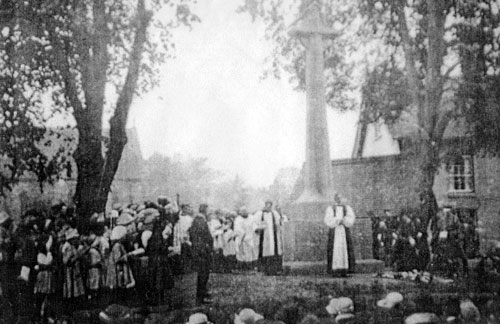
ECCLESHALL WAR MEMORIAL – UNVEILED BY THE EARL OF DARTMOUTH
The following article was taken from the Staffordshire Advertiser dated October 1st 1921 is reproduced here in full. It states that £360 was collected by private subscription, and this would be the equivalent of approximately £14,800 in 2017.
The memorial was executed in Dumfries stone by Mr. J. H. Beckett, A.R.I.B.A., of Longton, and the work carried out by Mr. C. W. Benton, stonemason, of Eccleshall and Stafford.
A handsome war memorial has been erected by the parishioners of Eccleshall to perpetuate the memory of the 44 men of the Parish who fell in the late war. There was a universal response to an appeal for private subscriptions and about £360 was collected in this way. Something like £330 has already been expended, and the remaining sum will go towards making suitable surroundings and a pathway to the church. Mr. J. Q. Lamb, C.C., of Horsley Hall, Eccleshall, acted as chairman of the committee, and the secretarial duties were carried out by Mrs. Moat, of Johnson Hall, Eccleshall.
The site selected for the memorial cross, just west of the lychgate of the Parish Church, is a most suitable one. This position makes the memorial a prominent feature, and the inscription is so placed as to be legible to all passing along the main road. The Parish Church of Eccleshall is of much interest and artistic merit. The tower has been erected at different dates; it presents a fine and imposing whole, and is the most conspicuous and the most important feature in the district. The committee were naturally of opinion that the memorial cross should be in harmony in all respects with the church: thus their motive in having the cross designed in late Gothic style. The base is imposing and severely simple: the shaft and head are restrained in design, and consist mainly of a cross superimposed upon a cross. The total height of the memorial is 21 feet. The whole was executed in Dumfries stone by Mr. J. H. Beckett, A.R.I.B.A., of Longton, and the work carried out by Mr. C. W. Benton, stonemason, of Eccleshall and Stafford.
It bears the inscription. “To the glorious memory of those from this parish who gave their lives for their country in the Great War, 1914-1919”, The names are hewn in the stone as follow :- Annie Elizabeth Allen, V.A.D., Harry Bache, Sidney Joseph Baker, Frank Beeston, William Blackstone, Arthur Herbert Bonner, Edward Gladstone Buttery, Arthur Morgan Carter, William Challener, John Clarke, Reginald Harry Talbot Croney, Ernest Davidson, John Francis Furber, Robert Buchanan Wilkes Gosse, William Alfred Gilbert, Nathan Goodrum, Peter Gallather, Alfred Grey, John Clayton Hall, Bertram Harding, Leonard Harding, Albert Hill, Horace Isaac Hill, George Hinds, Bertie Thomas Hitchen, Alfred Allman Hodson, Thomas William Hodson, Llewellyn Jones, Arthur Key, Edward Thomas Kinnersley, Bertram Machin Lindop, Vernon Lowe, Charles Maddox, James Marsdon, William Henry Neville, Frederick James Oakley, Frank Parton, Arthur Frederick Plant, Thomas Pitt, Richard Edward Sergeant, James Smith, Charles Orlando Sillito, Leonard Whittingham, Ernest Edward Wren, William James Wright. At the bottom are the familiar words – “Greater love hath no man than this, that a man lay down his life for his friends. Lest we forget.”
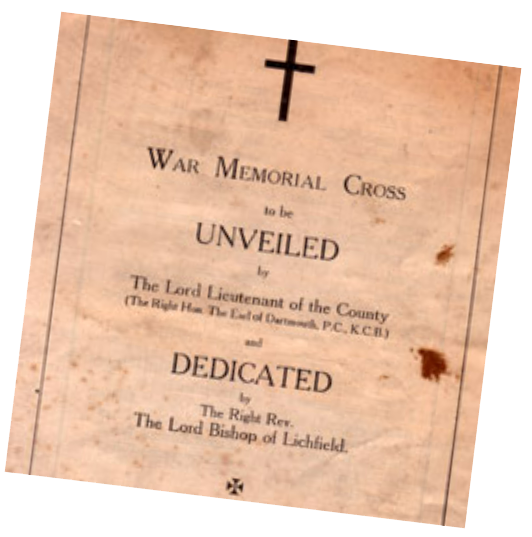
The memorial was unveiled and dedicated on Monday evening. There was a large attendance, and an enclosure was reserved for the relatives, who were flanked on the left be ex-Service men and on the right by the local detachment of V.A.D.s. Special constables were on duty as well as the police, under Sergt. McHugh. The Eccleshall school children formed up by the memorial near which stood the Lord Lieutenant of the county (the Earl of Dartmouth, P.C., K.C.B.), with Lady Dartmouth and the Dowager Lady Rayleigh; the Bishop of Lichfield (Dr. J. A. Kempthorne), who dedicated the memorial, having has his chaplain the Rev. G. Haddon Jones; the Vicar of Eccleshall (the Rev. R. G. Hunt), the Curate (the Rev. W. W. Holdcroft), the Rev. W. James (Wesleyan Minister, Stafford), Major W. Moat, Mr. J. Q. Lamb and Mr. W. Addison Yates (churchwarden).
An appropriate service commenced with the professional hymn “For all the Saints,” after the choir had come out of the church and formed up near the memorial. The lesson, taken from the third chapter of Solomon, was read by the Rev. W. James and the Major Moat read out the names on the memorial.
LORD DARTMOUTH’S ADDRESS.
After unveiling the memorial, Lord Dartmouth, in the course of an address, said he was glad to have the opportunity of performing the ceremony. What had been done in Eccleshall had been done throughout the country and in different countries. In almost every parish there had been the same desire to commemorate the names of those who fell. This had taken place or was taking place, but there were many points difference and many points of similarity; the names were different, the numbers were different, the circumstances in which the men fell were different, and even the regiments differed, and also the engagements in which the lives were lost. He understood that the parish of Eccleshall contained a population of 2,500 people and something like 350 had answered the call of whom 44 had fallen. There was one thing which distinguished the Eccleshall memorial from many others which he had been connected with, and that was it included the names of women, who played such a splendid part throughout the war. When the official history of the war came to be written, one of the finest chapters would be that which described the work of women. Lord Curzon had said that the work of the women in the war had put a new crown on the brow of woman. Those briefly were the points of similarity, in these days of unrest, suspicion, and jealousy it was something to find one thing, and that they were all British and ready to do honour to the men who gave their lives.
The burial of the Unknown Warrior in West Minster Abbey, conducted as it was by the leaders of the three great Forces – in the air, the sea, and the land – with the King as the chief mourner for the nation, and with all the ceremony and pomp, revealed a national tribute, and a national spirit of self -sacrifice which had bought them to the war. Let them remember that sacrifice mad for them by others were of no avail unless they themselves joined in those sacrifices. What they had to do today was to follow that example which those men who lost their lives had set. To those who had learned the bitter lessons of war he would say let them hope to find consolation in the courage with which those sacrifices were made. He himself felt that the knowledge of that courage and sacrifice went a long way towards sympathy for them. He also felt consolation in the knowledge that they had the sympathy of the whole world in their sorrow. In conclusion Lord Dartmouth said they had that day completed their memorial ceremony – the outward and visible sign. Let him impress upon them that that was only part of the memorial; let him, on behalf of the county, congratulate them on the successful issue, but the finest and most lasting memorial they could put up to those who had fallen was to do what they could do for those who were living.
As a representative of the subscribers, Mr. J. Q. Lamb, Chairman of the Eccleshall Parish Council, asked the Vicar to accept the memorial and that it should be solemnly dedicated and forever preserved. The Vicar accepted the memorial and charged the Parish Council to see that it was preserved. Psalm XV. was then sung.
A MESSAGE OF HOPE.
The Bishop of Lichfield dedicated the memorial, and, after doing so, he delivered an inspiring address, so, that was a great day in the town of Eccleshall. He alluded to St. Paul’s injunction to forget the things which were behind and reach forth to the things of the future. There were some things behind, continued his lordship, which they could never forget, and God forbid that they do so. The Lord Lieutenant of the county had rightly said they would never forget the men or the women who gave their best for them and made the great sacrifice during those awful years of war. It was not likely they should forget them, for there were many hearts there that day which were still sore in the sense, not of loss, because these men and women were not lost, but with the ache of long separation and the burning desire to see once more those who were everything to them. No, they would not forget their brave lads and brave women, nor again would they forget the great qualities which stood revealed in them during the war; their courage, devotion, self-sacrifice, loyalty, indomitable cheerfulness. The war did not make these qualities in men and women, but the war revealed them. Nor would they forget the spirit on unity which pervaded the county during those four grim years of war. They were one nation then; they fought together, fell together and strove together for the one great cause.
Nor would they forget Nov. 11 1918, when the news came that the country was saved and that victory was achieved for the cause of liberty and right. These were things they would not forget: St. Paul never meant them to forget such things as these, but there were some things they had better forget. It was no use now going back awful and tense anxiety of those four years. Those of them who had dear ones at the front were day after day torn with anxiety lest the message should come that their loved ones had fallen. It was difficult to forget, yet nothing was gained by dwelling on it. And once again, surely it was well they should forget the horrible and atrocious deeds continued during those years.
He did not doubt there were deeds done by which their enemies should be branded with ignominy in the histories that would have to be written. He believed those lads would say they wanted to forget it all, but it would be in vain of them to indulge in the luxuries of hate, for if they did so their children would be likely to have the luxury of another war, from which might God preserve them. He thought it was just as well they should forget some of the events that had happened and of the spirit shown by certain sections of the nation since the Armistice. They could not be altogether proud of the nation when they looked back the past few years. Rather should they want to look forward and say these things shall be of the past, and, please God, in the time to come they going to prove themselves more worthy of the men who laid down their lives and reach forward to the things that were before. He did not think this only meant looking forward into the far distant future, but a nearer future had to be thought of. What was to be the future of England, the British Empire, and world during these coming years!
There were among them children. What were they going to see during their lifetime? Another war, God forbid. Surely on a day like that – symbolic of eternal sacrifice, with God before their eyes, the meant to dedicate themselves to carry on the work which those men and women did during the war and show that they could be a united people in peace as in victory. He knew there were things that divided them; they did not all think alike, but it was not necessary to think alike, provided they had one great purpose which united them. There were interests which clashed between section and section and class and class, but the interests which untied them were far greater than those which divided them. If they went forward with the single-hearted purpose to do justice and good-will and to get rid of the spirit of suspicion, and make up their minds they would arrive at the common good and reach forth to the things which were before them, then all would be well. But they must remember this could not be achieved except by making sacrifices. Every one of them must be prepared to make sacrifices. It was clear they not worthy to erect a monument unless they strove to live for the things for which their brave men and women died. Then they could look forward to the further future.
Concluding, the Bishop addressed the relatives. He said it was worth while to look forward and to believe the passing of their loved ones was only for a time. Death could never destroy life, and one day in the presence of God they would all be re-united. Let them forget the things behind, except the men whom they loved, and reach forward to the things that were before with confident hope that God would give their endeavours a spirit of hope and sacrifice.
The hymn “O valiant hearts” followed, and the Bishop pronounced the Benediction. The “Last Post” was sounded by Trumpeters Coates and Talent, of the Stafford Battery, R.F.A, and a few moments silence they blew the Reveille.
A large number of wreaths were placed at the base of the memorial by the bereaved and by friends. These included one from the local branch of the Comrades of the Great War and one from the Eccleshall Lodge of the Manchester Unity of Oddfellows.